


Eduardo Grin is an associate professor at Fundação Getulio Vargas (Brazil), professor at the Universidad del Valle (Colombia) and at the National School of Public Administration (Brazil).

Johanna Schnabel is a lecturer and researcher at the Chair of German Politics, Otto Suhr Institute of Political Science, Freie Universität Berlin.

Mario Kölling is a professor at the Department of Political Science, Spanish National Distance Education University (UNED) in Madrid, and senior researcher at the Fundación Manuel Giménez Abad in Zaragoza.

Joel Mendoza Ruiz is a full-time research professor, level “D”, at the Autonomous University of the State of Mexico, currently affiliated with the Cuautitlán Izcalli Professional Academic Unit.
Abstract
Comparative federalism has largely neglected Ibero-American federations. Drawing on our Handbook on Federalism in Ibero-America, this contribution we ask whether Argentina, Brazil, Mexico and Spain are federations and whether they form a distinct Ibero-American model. Applying Fenna and Schnabel’s minimal definition, we find that all four fulfil the criteria of constitutional recognition and a direct relationship with the people, but only partly that of entrenchment, while their constituent units lack meaningful autonomy. Comparing the division of powers, fiscal federalism and intergovernmental relations, we identify shared features, notably the extensive use of framework legislation and executive, centrally steered intergovernmental relations. Yet these features vary across the cases and resemble patterns in other federations. There is thus no distinct Ibero-American model; rather, these are centralised variants of familiar federal patterns. What is distinctive is their trajectory: federalisation was closely tied to democratisation, although the relationship between federalism and democracy remains ambivalent.
Introduction
Comparative federalism has been built largely on a small set of “classical” cases: Australia, Canada, Germany, Switzerland, and the United States. Federal and quasi-federal systems in Ibero-America have received much less broader attention, and when these countries are studied, it is mostly as individual cases or within a regional literature, typically in Portuguese or Spanish, that rarely speaks to the broader field. Our Handbook on Federalism in Ibero-America tries to fill this gap[1].
The analysis covers Argentina, Brazil, Mexico and Spain. The three Latin American countries are officially federations according to their constitutions. Spain’s State of Autonomies is not officially federal, the Spanish Constitution does not even mentioning the term, but it is widely regarded as having federal features (Tudela & Kölling, 2020]. The comparison of these four countries rests on shared historical and legal traditions, including colonialism and Catholicism, a common legal culture, and a recent authoritarian experience. In all four countries, federalism can only be understood against the backdrop of this authoritarian past. In Argentina, Brazil and Mexico, the constituent units retained some degree of autonomy during the different dictatorships, albeit with diminished powers. In Spain, by contrast, regional institutions had to be (re)created after Franco. In all four cases, federalism and the transition to democracy were part and parcel, as was the case in Germany, even though for different reasons.
Whether these shared historical and legal traditions translate into a common federal design is precisely the question the Handbook sets out to answer. Studying these cases as federations is a matter of classification. It allows us to test whether concepts developed for classical federations travel to systems shaped by different historical trajectories and examine how the four Ibero-American countries compare to classical cases. However, it is also about more than classification. Understanding the federal nature and operation of federalism in Argentina, Mexico, Brazil, and Spain is necessary for understanding how public policy is made and delivered, and how these countries deal with the challenges of modern democratic governance.
The book has two main objectives. The first is an assessment of whether these countries are federations, that is to what extent their constituent units enjoy meaningful autonomy vis-à-vis a strong central government. The second objective is to compare these countries and establish whether there is a distinct Ibero-American model of federalism—or if the structural, constitutional and institutional characteristics and dynamics of these cases conform to patterns observed elsewhere.
Are Argentina, Brazil, Mexico and Spain Federations?
A federation comprises (at least) two orders of government that enjoy constitutional recognition, each with a direct relationship with the people and meaningful autonomy, and whose status and powers are constitutionally entrenched (Fenna & Schnabel, 2024; 2025). This definition encompasses a broad range of federal models, including dual, administrative, coming-together, and holding-together federations, as well as centralised and decentralised ones (Dardanelli et al., 2019; Mueller & Fenna, 2022; Stepan, 1999).
Meaningful autonomy requires powers that are not “of an entirely trivial nature”, that is, in at least one of the main areas of modern government (Fenna & Schnabel, 2024, p. 182), including the authority to decide on its own system of government. Powers limited to implementing the other order of government’s policies count only if they involve significant, constitutionally entrenched discretion. Constitutional entrenchment means that neither order can unilaterally abrogate the division of powers or remove the other’s status or authorities, and any provisions for intervention are subject to strict conditions. Constitutional amendment requires the consent of the constituent unit governments or of a majority of the people in a majority of the units.
Two orders of government with constitutional recognition. Argentina, Brazil, Mexico, and Spain clearly meet this criterion. Each country has a central government alongside provinces, states or Autonomous Communities whose existence is recognised in the constitution; in Brazil, this includes the municipalities, which are also a constitutionally recognised order of government. In Spain, the Constitution recognises the right to autonomy, while the Autonomous Communities themselves were constituted through their Statutes of Autonomy. Each order of government has a direct relationship with the people. Both (or all three) orders of government have their own elected executives and legislatures, which are accountable to their own citizens and act directly upon them.
Constitutional entrenchment. In all four countries, the status and powers of the constituent units cannot be altered unilaterally by ordinary central government legislation; in Spain, the Statutes of Autonomy cannot be reformed without regional consent. Constitutional amendment, however, requires the consent of the constituent units only in Mexico, where amendments must be approved by both chambers of Congress and a majority of state legislatures. In Argentina, Brazil and Spain, the constitution can be amended without the constituent units’ consent. In Argentina, however, constitutional amendment involves a constituent assembly and a referendum. In Spain, the Autonomous Communities can request a constitutional amendment and changes to the distribution of power require amendment of the Statutes of Autonomy, which, in turn, requires the consent of both orders of government. Hence, this criterion is only met in Argentina, Mexico, and Spain, with Brazil falling short. All four constitutions provide for central intervention in the constituent units; however, this is under specified conditions, and its use has become limited.
Meaningful autonomy. This is where the four countries clearly fall short. In all of them, the central government holds exclusive or concurrent powers, including the authority to adopt framework legislation, in virtually every major policy area. Exclusive constituent-unit jurisdiction is largely absent in key domains of modern government, such as health, education, welfare and infrastructure. The constituent units deliver many services, but they do so within parameters set by central legislation. Their discretion in implementation is significant in some cases, notably in Argentina, Brazil, and Spain but it is only partially protected by the constitution and court rulings. In contrast to the constituent units in Australia, Canada, Germany, Switzerland or the United States, they therefore act to a considerable extent as agents of the central government rather than as autonomous policymakers. The extent to which they can decide on their own system of government varies. Argentine provinces have significant institutional autonomy, as they can choose their own system of government and electoral system; Spain’s Autonomous Communities enjoy some discretion within their Statutes of Autonomy; and Brazilian and Mexican states must adopt the presidential system and electoral system prescribed by the federal constitution.
Why (still) study Ibero-American Federations?
If the policy autonomy of the constituent units is so constrained, why should we still analyse these systems as federations? We see several reasons.
First, provinces, states and Autonomous Communities are not creatures of the central government. In contrast to unitary countries like France, Portugal or Chile—or even decentralised unitary countries like Colombia, Denmark or Sweden—they were not established by central legislation. They exist, like the central government, due to constitutional provisions that the centre cannot change by ordinary legislation. Therefore, these systems are structurally closer to federal countries than to unitary countries.
Second, the constituent units play a crucial role in the operation of these political systems. They implement and administer a large share of public policies, and regional leaders are key figures in national politics. During the COVID-19 pandemic, several Brazilian states adopted protective measures that the Bolsonaro government refused to enact. In Spain, left-wing and right-wing minority central governments alike have only come to power with the support of Catalan, Basque or Galician regional parties. In Argentina, governors control electoral lists and seats in Congress, and their loyalty—or rebellion—has been decisive in moments of crisis, as in 2001.
Third, the constituent units have shown a capacity to accommodate diversity and to innovate. With the exception of Mexico, Ibero-American federations are good examples of laboratory federalism, in which policy innovations and participatory models have diffused to other units or to the central level, notably in Brazil.
A Distinct Ibero-American model?
A distinct Ibero-American model would mean that Argentina, Brazil, Mexico, and Spain are most similar to each other and most different from federations in other parts of the world. This is not what we find.
Division of powers. The most important similarity is strong legislative centralisation through exclusive central powers and the vast use of framework legislation in most policy fields. However, the four countries differ in the discretion that framework legislation leaves to the constituent units. Mexican states have very limited scope to implement national laws, whereas the Spanish autonomous communities typically develop extensive central standards. They also differ in how concurrency operates; Brazil, for example, distinguishes exclusive administrative from “privative” central powers and has constitutionally mandated national unified systems in health, education and social assistance. All four combine features of administrative federations similar to Germany, Austria, and Switzerland, where the central government legislates and the constituent units implement these decisions, with features of dual federations comparable to the United States, Canada, and Australia, where the central government implements its own policies. Ibero-American federations are neither clearly administrative nor clearly dual (Mueller & Fenna, 2022). In this, they are also not distinct, as even the United States has gained features of administrative federalism over time.
Fiscal federalism. In all four countries, the central government exercises a broad federal spending power, comparable to that in Australia, Canada and the United States, and in all four, decentralisation is more pronounced on the expenditure than on the revenue side. Beyond these similarities, the variation is considerable. Mexico is the most fiscally centralised case and resembles Austria, Ethiopia, and South Africa rather than its Ibero-American peers. Argentina and Spain are closer to Australia, India, and Belgium, while Brazil is as fiscally decentralised as Switzerland or the United States. Brazil’s constitutionally entrenched revenue sharing resembles Germany’s, whereas in Mexico the central government decides on revenue sharing unilaterally. Conditional grants are a key instrument in Argentina, Brazil and Mexico, but play a limited role in Spain, where most transfers are unconditional.
Intergovernmental relations. The clearest common pattern concerns how constituent units participate in central decisions. Short answer: They do not. Second chambers are the formal channel, but in all four countries senators are directly elected—except for about a fifth of Spanish senators which are designated by regional parliaments—and vote along party lines. In Brazil, membership of the president’s coalition explains senators’ votes better than their state of origin. Spain’s Senate, constitutionally “the chamber of territorial representation”, is largely marginal; territorial bargaining takes place in the Congress, where Catalan and Basque parties have extracted concessions from minority governments.
IGR, by contrast, like in other federations, have become a key part of the operation of the federal system. They are, however, predominantly vertical and centrally steered. Peak councils are few and recent. Brazil’s Council of the Federation was created by presidential decree in 2023 and is chaired by the President. Spain’s Conference of Presidents meets irregularly despite standing orders foreseeing regular sessions. Argentina has no generalist council, and Mexico none of a vertical kind. Sectoral councils show more variation. Brazil’s tripartite commissions in health and social assistance adopt legally binding rules by consensus, and the federal government, though dominant, cannot simply impose its preferences. Mexico’s health and education councils, by contrast, are formally institutionalised but serve top-down coordination. In Spain, the Fiscal and Financial Policy Council gives the central government a voting bloc equal to that of all Autonomous Communities combined. In consequence, rather than acting as federal safeguards, intergovernmental councils serve largely as tools of the central government to promote and implement its agenda.
Horizontal cooperation is weak or inexistent. The exception is Brazil, which has a Forum of Governors, interstate consortia such as the Northeast Consortium and more than 4,700 inter-municipal consortia. Mexico’s CONAGO is only a weak horizontal council which mainly issues statements addressed to the President. Intergovernmental agreements are predominantly vertical and bilateral, which can serve the purpose of accommodation, as with the Basque Country and Navarre, or create division, as in Mexico between 2018 and 2024. Formal consultation or co-decision requirements are scarce and concern implementation rather than policy design.
None of these features is distinctively Ibero-American. Vertical generalist councils resemble those of Australia rather than Germany or Switzerland, and directly elected, party-driven senates follow the US template. In having both vertical and horizontal councils, Argentina and Brazil are closer to Canada and Germany than to Mexico and Spain.
Table 1. A distinct Ibero-American model? Key features in internal and international comparison
|
Features |
Internal comparison | International comparison |
| Division of powers | • Similarity: importance of framework legislation; re-centralization
• Variation: discretion under framework legislation, concurrency; level of centralization |
• More centralized than ‘classical’ federations
• IbAm federations are less centralized than, e.g., Malaysia |
| Fiscal federalism | • Similarity: Broad FSP
• Variation: degree of fiscal de/centralization, authority over VAT, revenue-sharing mechanisms, conditional grants, FEQ |
• Broad FSP = AUS, CAN, USA
• Constitutionally mandated revenue sharing in BRA = DEU • Implicit FEQ in ARG, BRA, MEX (= US) |
| IGR | • Similarity: vertical councils, bilateral IGA; weak horizontal IGR à top-down
• Variation: horizontal generalist council in MEX (but weak), interstate consortia BRA |
• Advisory role; distinctive weakness?
• Generalist councils like in other federations, mostly vertical generalist council (= AUS; ≠ DEU, CHE) |
Source: Authors’ elaboration based on Grin et al. (2026). Note: FSP = federal spending power; FEQ = fiscal equalisation; IGA = intergovernmental agreements.
Conclusion and Research Agenda
Argentina, Brazil, Mexico and Spain fulfil the criteria of constitutional recognition and direct relationship with the people, partly fulfil that of entrenchment, but exhibit a lack of meaningful autonomy of the constituent units. They share some features—most notably the extensive use of framework legislation—but these features vary across the four and resemble features in other federations. Thus, there is no distinct Ibero-American model; these are centralised variants of familiar federal patterns. IGR rule, in particular, is a matter of executives, centrally steered, and largely confined to implementation.
What is distinctive, however, is the trajectory. In Ibero-America, decentralisation and federalisation were closely tied to the return of democracy after decades of authoritarian rule; they were seen as instruments to prevent authoritarian reversals and bring government closer to citizens. The relationship between federalism and democracy remains, nevertheless, ambivalent. Brazil’s federal structure was one of the barriers to democratic backsliding under Bolsonaro. In Argentina and Mexico, by contrast, democratic erosion has gone hand in hand with attacks on federalism, through recentralisation in Mexico and cuts and suspensions of transfers in Argentina.
Several questions follow for comparative research. First, how do these federations address territorial inequalities, corruption and democratic backsliding, and does their federal structure help or hinder? Unequal state capacity across constituent units is a key factor here. Second, are federations and quasi-federations in other regions similarly centralised variants of classical patterns? Third, how can we assess whether autonomy is meaningful rather than merely formal? Finally, new challenges—gender equality, climate change, the effects of supranational integration and the rise of authoritarian populism—will shape the balance between centralisation and decentralisation in the coming years. Our book touches upon these challenges and points to need for further systematic and comparative research—across Ibero-American federations and with other federal countries.
[1] The authors would like to thank the Forum of Federations, particularly Liam Whittington, for their support in editing this volume. The book also reflects the contributions of an international team of experts whose knowledge and insights were vital to the success of the project.
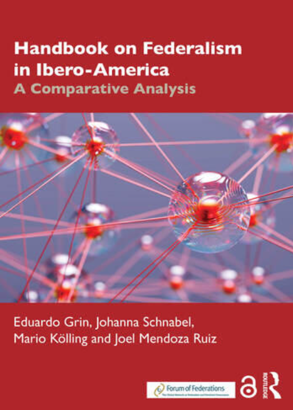
The Handbook on Federalism in Ibero-America is now freely available as an Open Access ebook. Download the full PDF here: https://www.taylorfrancis.com/reader/download/c27d36b4-c319-4704-baeb-fba4a1cc1618/book/pdf?context=ubx
References
Dardanelli, P., Kincaid, J., Fenna, A., Kaiser, A., Lecours, A., & Kumar Singh, A. (2019). Conceptualizing, measuring, and theorizing dynamic de/centralization in federations. Publius: The Journal of Federalism, 49(1), 1–29. https://doi.org/10.1093/publius/pjy036
Fenna, A., & Schnabel, J. (2024). What is Federalism? Some Definitional Clarification. Publius: The Journal of Federalism, 54(2), 179–200. https://doi.org/10.1093/publius/pjad034
Fenna, A., & Schnabel, J. (2025). Defining Federalism: A Rejoinder to Hueglin and Mueller. Publius: The Journal of Federalism, 55(2), 408–413. https://doi.org/10.1093/publius/pjaf005
Grin, E., Schnabel, J., Kölling, M., & Mendoza Ruiz, J. (Eds.) (2026). Handbook on Federalism in Ibero-America: A Comparative Analysis. Routledge (Open Access: https://www.taylorfrancis.com/reader/download/c27d36b4-c319-4704-baeb-fba4a1cc1618/book/pdf?context=ubx).
Mueller, S., & Fenna, A. (2022). Dual versus Administrative Federalism: Origins and Evolution of Two Models. Publius: The Journal of Federalism, 52(4), 525–552. https://doi.org/10.1093/publius/pjac008
Stepan, A. (1999). Federalism and democracy: Beyond the U.S. model. Journal of Democracy, 10(4), 19–34. https://doi.org/10.1353/jod.1999.0072
Tudela Aranda, J., & Kölling, M. (2020). Spain (Kingdom of Spain): A union of autonomous communities. In A. L. Griffiths, R. Chattopadhyay, J. Light y C. Stieren (Eds.), The Forum of Federations handbook of federal countries 2020 (pp. 329–340). Palgrave Macmillan. https://doi.org/10.1007/978-3-030-42088-8_24
Further Reading
Grin, E., Schnabel, J., Kölling, M., & Mendoza Ruiz, J. (Eds.). (2026). Handbook on federalism in Ibero-America: A comparative analysis. Routledge.
Mendoza Ruiz, J., & Grin, E. (Eds.). (2023). Las salvaguardas federales en Argentina, Brasil y México: Relaciones, límites y contrapesos. Universidad Nacional de Córdoba.
Mendoza Ruiz, J., & Grin, E. (Eds.). (2020). Federaciones de las Américas: Descentralización, relaciones intergubernamentales y recentralización. INAP / UAEMex.
Majeed, A., Watts, R. L., & Brown, D. M. (Eds.). (2006). Distribution of powers and responsibilities in federal countries (Global Dialogue on Federalism Series, Vol. 2). McGill-Queen’s University Press.